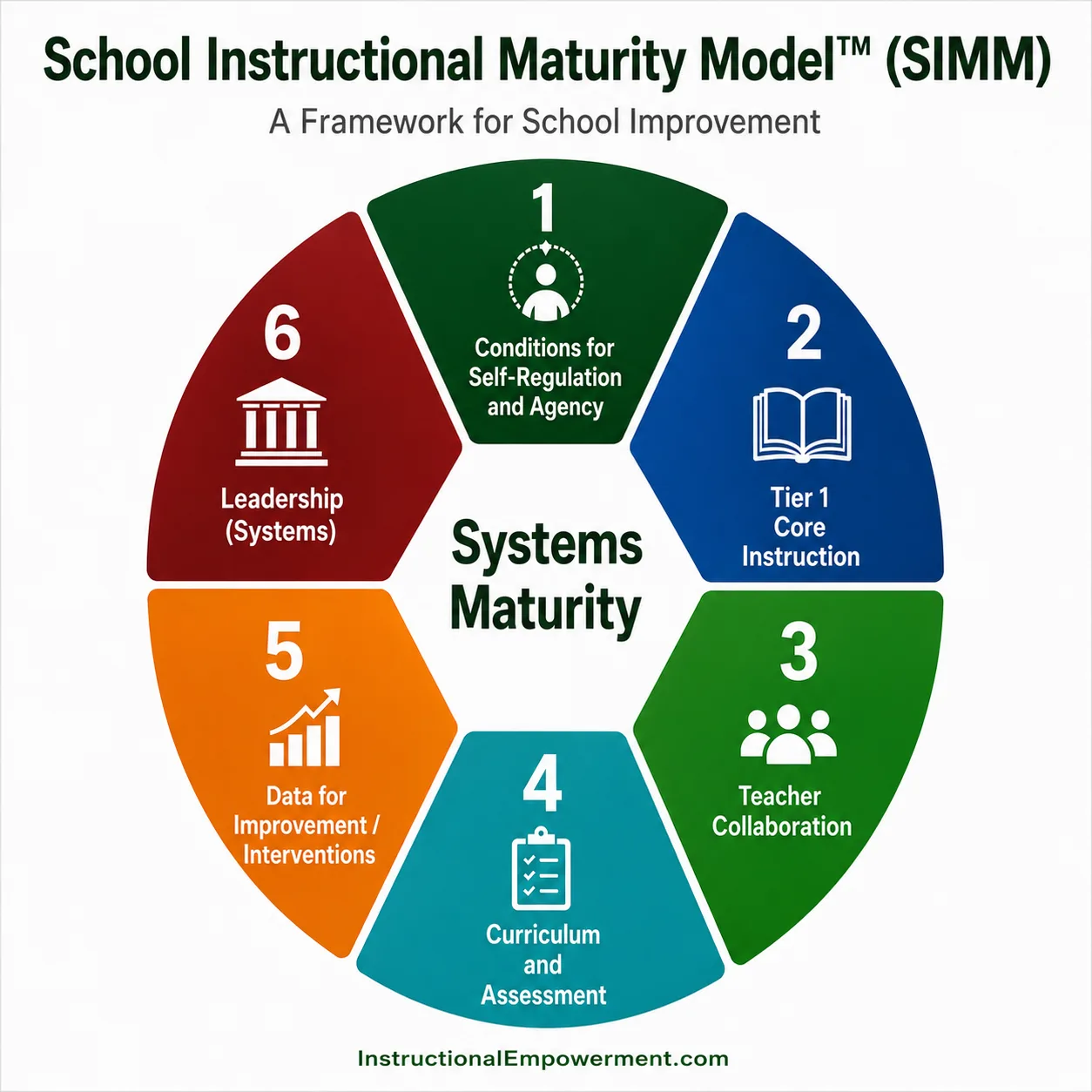
Together, these pillars address the human systems that sustain school improvement: how teachers collaborate and drive innovation, and how leaders create the conditions that make continuous improvement possible.
Peer-Reviewed Study of Leadership Style & Teacher Innovation | Discover Education (2026)
A peer-reviewed longitudinal study published in Discover Education followed 422 teachers in 41 elementary, middle, and high schools across 11 districts in seven states as they adopted the Model of Instruction for Deeper Learning®. It connects how leaders lead (Pillar 6) with how teachers adopt instructional change (Pillar 3).
Using a two-wave teacher survey and multilevel structural equation modeling, the study found:
- Each of the four leadership styles studied had a significant indirect effect on teachers’ adoption of the Model of Instruction for Deeper Learning®, through autonomy satisfaction, autonomy frustration, and teacher innovativeness
- Teacher innovativeness had the strongest positive association with adoption of the Model of Instruction for Deeper Learning®, regardless of leadership style, teacher autonomy, or years of experience
- Supportive leadership styles fostered adoption, while restrictive, hierarchical styles hindered it
Source: Basileo, L. D., Lyons, M. E., Toth, M. D., Otto, B., & Hofmann, F. (2026). The Indirect Effects of Leadership Style on Teacher Innovation Adoption Mediated by Autonomy Satisfaction, Frustration and Innovativeness. Discover Education. https://doi.org/10.1007/s44217-026-01982-0
Peer-Reviewed Study of Early Adopter Teachers | Emerald Insight (2024)
A peer-reviewed study published in Emerald Insight by Instructional Empowerment’s Applied Research Center explored what motivates early-adopter teachers to implement education innovations such as the Model of Instruction for Deeper Learning® and what school leaders can do to support them. It directly addressed teacher collaboration (Pillar 3) and leadership support (Pillar 6).
Using triangulated data from over 600 teacher surveys and interviews, the study found:
- Early-adopter teachers play a pivotal role in spreading innovation across schools
- Teachers’ motivation and support systems significantly affect the success of implementation
- School leaders can drive change by fostering autonomy, competence, and collaboration among teachers
Source: Basileo, L. D., & Lyons, M. E. (2024). An Exploratory Analysis of Early Adopters in Education Innovations. Quality Education for All (Emerald Insight). https://doi.org/10.1108/QEA-10-2023-0009
Peer-Reviewed Study of Coaching & Student Achievement | SAGE Open (2024)
A peer-reviewed study of 53 schools published in SAGE Open found that the more coaching days a school received, the greater the gains in student achievement in both ELA and math. Results were statistically significant, reinforcing that leadership-driven coaching systems (Pillar 6) directly elevate teacher practice (Pillar 3) and student outcomes.
Source: Basileo, L. D., Lyons, M. E., & Toth, M. D. (2024). Leading Indicators of Academic Achievement: Investigating the Predictive Validity of an Observation Instrument in a Large District. SAGE Open. https://doi.org/10.1177/21582440241261119
Peer-Reviewed Study of Leadership & Teacher Burnout | Journal of Educational Psychology (Forthcoming, 2026)
A study accepted for publication in the Journal of Educational Psychology extended autonomy-supportive teaching theory to school leadership. It used a two-wave survey of 570 teachers in 42 schools across 8 districts in 7 states and connects leadership systems (Pillar 6) with the teacher experience that sustains collaboration (Pillar 3).
Using multilevel structural equation modeling, the study found:
- Autonomy-supportive leadership predicted lower autonomy frustration (β = –.32), higher autonomy satisfaction (β = .35), and lower teacher burnout (direct β = –.13)
- Autonomy frustration, not satisfaction, carried the indirect effect on burnout (indirect β = –.20)
Source: Lyons, M. E., Basileo, L. D., Otto, B., & Toth, M. D. (2026). Autonomy-Supportive Leadership and Teacher Burnout: A Multilevel Motivational Model of Direct and Indirect Effects Through Autonomy Frustration. Journal of Educational Psychology. Accepted for publication; link to be added when published.
Peer-Reviewed Study of Leadership & Teacher Innovativeness | International Journal of Leadership in Education (Forthcoming, 2026)
A study accepted for publication in the International Journal of Leadership in Education (accepted October 15, 2026; also presented at the American Educational Research Association annual meeting in 2025) surveyed 1,408 teachers in 71 low-performing schools in 11 districts across seven U.S. states about their implementation of the Model of Instruction for Deeper Learning®. It addresses teacher collaboration (Pillar 3) and leadership support (Pillar 6).
The study found:
- Teacher innovativeness had the largest association with implementation
- Autonomy satisfaction and autonomy frustration were also significant
- Leadership style effects were reduced after accounting for autonomy
Source: Basileo, L. D., Lyons, M. E., Toth, M. D., Otto, B., Carmignola, M., & Hofmann, F. (2026). A Key to Unlocking Reform in Education: Autonomy-Supportive Leadership and Teacher Innovativeness. International Journal of Leadership in Education. Accepted for publication; link to be added when published.